
10 Essential Lessons for a Digital Artist Today
A realistic roadmap beyond hype, where digital art confronts history, failure, and the responsibilities of culture

🇮🇹 Clicca qua per la versione in italiano - click here for the italian version
Preface – The Myth of the New Beginning
Web3 was presented as a ground zero: a new beginning, a tabula rasa capable of overcoming the traditional art system. That did not happen.
The progressive shutdown of historic marketplaces, NFT platforms, and so-called “decentralized” projects is the most objective fact we have. This is not a cyclical downturn; it is the structural failure of a model that confused market with culture, speed with vision, community with system.
The mistake was not technological, but cultural: an attempt was made to build an art ecosystem while ignoring centuries of practices, roles, mediations, and responsibilities. This article is not an act of nostalgia, but an attempt to restore order.
1. Know art history (and study those who succeeded)
There is no serious artist who does not know what came before them.
Even Leonardo da Vinci was not an “isolated” genius: he studied the classics, observed masters, copied, dismantled, and rebuilt.
Maurizio Cattelan built his strength not on technique, but on a lucid understanding of the mechanisms of art, symbolic power, and the media.
Anish Kapoor and Jeff Koons, two of the best-known contemporary artists today, brought industrial production into the art system only after understanding its rules.
An artist who wants to be a credible subject in the art world has the duty to know it; as someone who aims to enter the art market sustainably, they must ensure that what they produce has not already been done and can find its place within that market. They owe this to collectors willing to invest in them, to their own career, and to the curators and critics who choose to associate their names with theirs.
Studying these paths does not mean imitating them, but understanding how artistic success works over time—not in the feed.
Useful Sources
2. Accept that the Web3 model has failed
Web3 promised disintermediation, but created new dependencies: on fragile and poorly supported blockchains, on centralized marketplaces often run by people with little experience of the art world and its market, and on short, frantic hype cycles that leave emptiness after brief storms.
The closure of platforms such as Nifty Gateway, MakersPlace, or Rodeo is not an anomaly; it is the logical consequence of a system that focused everything on liquidity and fast speculation, and nothing on culture.
What were once the noble and revolutionary principles of Web3 were distorted and bent to dubious profit logics, emphasizing the idea of easy money and drawing into this world a multitude of self-styled, improvised “artists.”
Those who keep talking about a “restart” without questioning past mistakes are merely prolonging the agony.
Further reading
3. Separate artistic value from visibility
Art is not engagement. An artist is not the same as a creator.
Many Web3 projects confused community growth with the construction of cultural value. The result was an ecosystem populated by figures closer to marketing than to artistic research.
On social platforms linked to Web3, audience-farming logics were often treated as the only viable approach to so-called artistic projects. This excluded from the spotlight many proposals that actually had something to say but were not supported by mass social metrics.
Visibility is not a criterion of quality. At most, it is an amplifier. A digital artist today should reconnect with a more appropriate concept of value and place the pursuit of quality—or research more broadly—back at the center of their strategy.
4. Put content, narrative, and idea back at the center
Historical avant-gardes had already made this clear. Dadaism, punk, and conceptual art showed that the medium is not the message if the message does not exist.
Today, the obsession with terms such as “immersive,” “interactive,” or “AI-powered” has produced countless works that are technically brilliant but conceptually empty. These are precisely the buzzwords filling the content produced and circulated by industry influencers—often people who, until recently, worked in entirely different fields, frequently digital marketing.
Art cannot exist without a concept behind the form; art is the unexpected and brilliant intertwining of form and substance, the necessary and uncontrollable emergence of something from the artist. A true artist does not produce for pleasure or strategy, but because they cannot do otherwise: art is an absolute necessity for them.
Without a strong idea, technology is mere decoration.
References
5. Defend research and the right to destruction
In the traditional art system, the public saw only the final work. Today everything is published, documented, promoted, and the pursuit of engagement is so obsessive that nothing is withheld from global visibility.
This has eliminated a fundamental phase: destruction.
An artist must be able to fail in private. They must be able to discard 90% of what they produce. This phase has always been essential: works that do not fully embody the formal and conceptual intent of the artist must be eliminated without hesitation. What leaves the artist’s studio—or today, their wallet—should be the definitive selection of their entire creative process.
Without this selection, what remains is serial content production. And that process is not called “making art”; it is called product placement.
6. Think of works as parts of a project
A work of art is not a post.
Artists work in cycles, series, phases. Works must dialogue with each other and build a recognizable poetics. When an artist presents themselves to a gallery, museum, or foundation, they are expected to present their production as projects; rarely do artists work on isolated pieces.
A work detached from a broader project is often weakened.
Those who produce isolated, disconnected works designed only to “work” online do not build a path; they build a disordered archive.
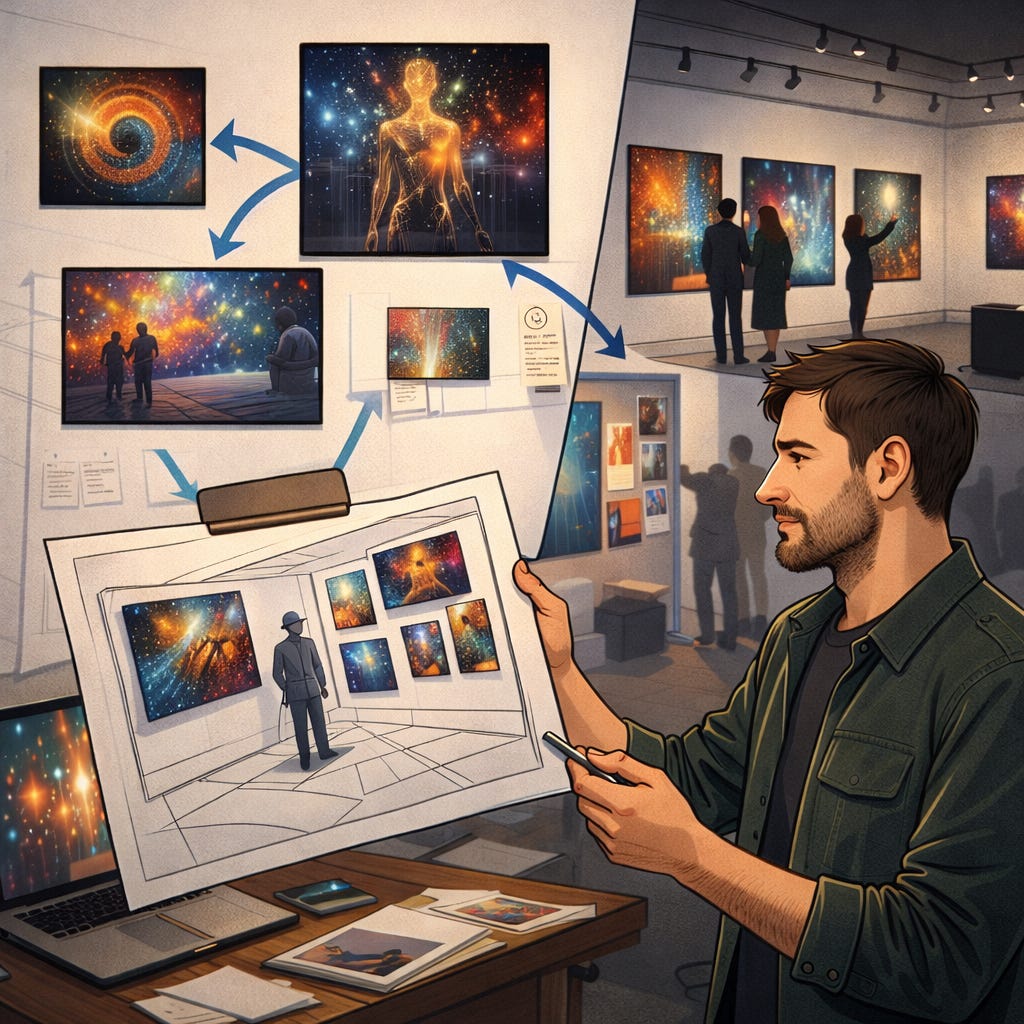
7. Design the outcome: exhibition, format, space
A digital artwork must be able to exist beyond the artist’s personal screen.
It must be exhibitible in a gallery, museum, or fair. If an artist wants to interact with the main players of the art world, they must put themselves in their place and think about their needs—especially when it comes to building exhibitions.
Today, the central element of contemporary art dissemination is not the artwork but the exhibition. Curators, directors, critics, gallerists, and journalists think in terms of exhibitions, not individual works.
From the moment of conception, a work must already have a format, a device, an installation logic.
Artists who ignore this aspect exclude themselves from the physical art system, which—like it or not—remains the place of legitimation and historicization.
8. Build relationships with critics and curators
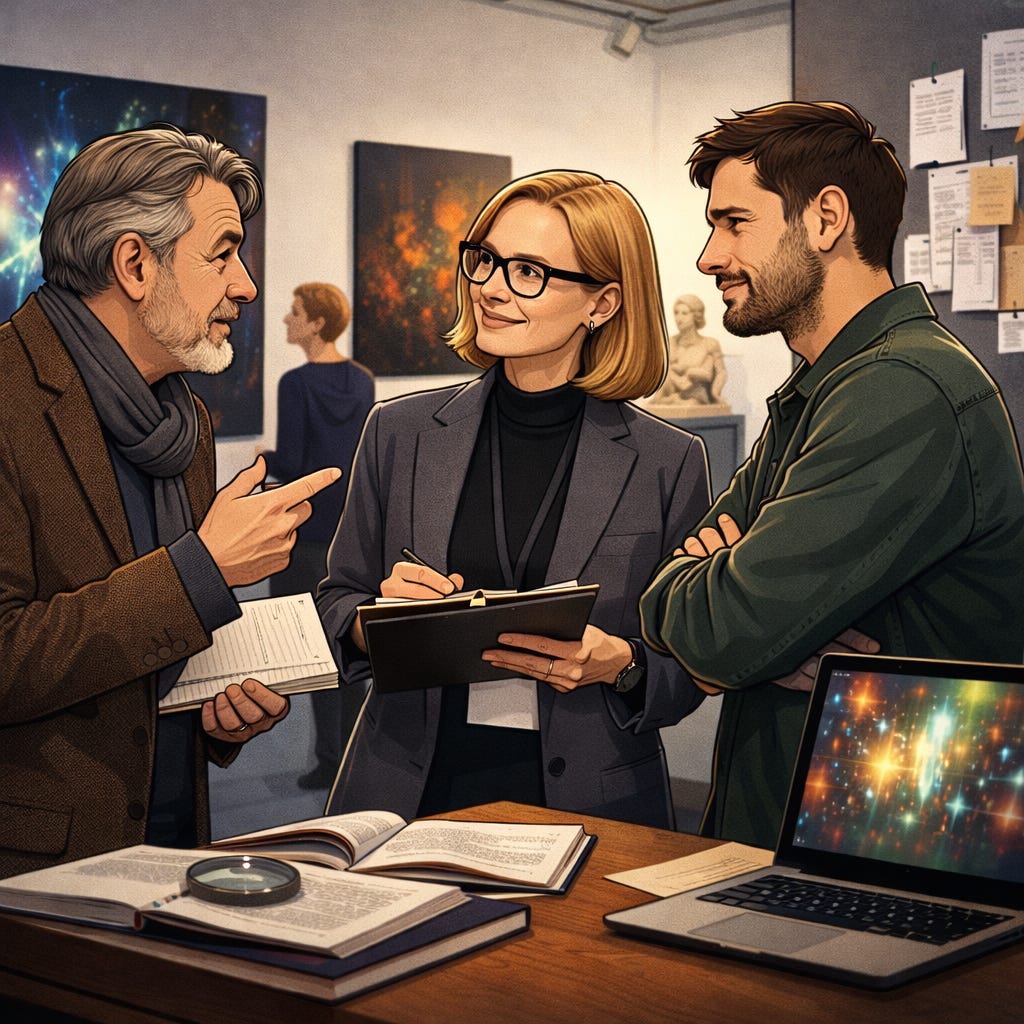
Web3 demonized mediating figures. This was likely a mistake, especially since the idea of disintermediation was applied inconsistently, depending on who stood to profit at the time.
Without critics and curators, there is no cultural sedimentation, no historical narrative, no institutionalization.
Art has always needed those who can narrate it, select it, filter it from the vast production generated every day. Writing about art, critiquing art, selecting art, curating exhibitions are complex tasks requiring preparation, experience, and knowledge of past and present art. Historically, these roles helped build an art system capable of surviving and remaining sustainable over centuries.
Those who can read and write art are not obstacles; they are strategic allies.
Further reading
9. Ensure preservation and standards
A digital artwork is also an archival problem. Just as traditional artists had to face conservation issues—often with serious consequences—the same responsibility now falls on digital artists, albeit within different paradigms.
Today we often encounter disappearing blockchains, unsupported IPFS links, non-standardized files. All of this undermines the trust of collectors, who already took a leap of faith by embracing immaterial forms of collecting.
The methods may change, but the substance does not: art, material or not, must be guaranteed over time.
Those who sell art bear a responsibility similar to that of a publisher or a museum: ensuring durability.
References
10. Do not follow trends
Trends produce only armies of imitators.
Web3—at least in the timid version we have seen so far—proved this: cloned aesthetics, recycled themes, indistinguishable languages.
Nothing new under the sun: art history is full of moments of creative flattening and waves of conformity affecting both producers and buyers. What endures is originality and innovation.
The artists who remain are those who had the courage to be out of time, out of trend, out of comfort. Thinking against the current, imagining uncharted paths, offering the world an entirely new perspective—these are essential traits of artists. The artist is, by nature, anti-conformist. As Gerhard Richter aptly said: “Art does not serve to transmit messages or ideologies; it serves to resist the simplification and flattening of the world.”
Conclusion
Being a digital artist today does not mean using the latest technology, but knowing why you use it.
After the collapse of hype, the choice is clear: continue producing noise or return to making art.
The art system is not dead. It is simply more demanding than many had anticipated.
Grazie Claudio, sempre super interessante